Renewable Natural Gas: A Stable, Proven Advantage for Trucking Fleets
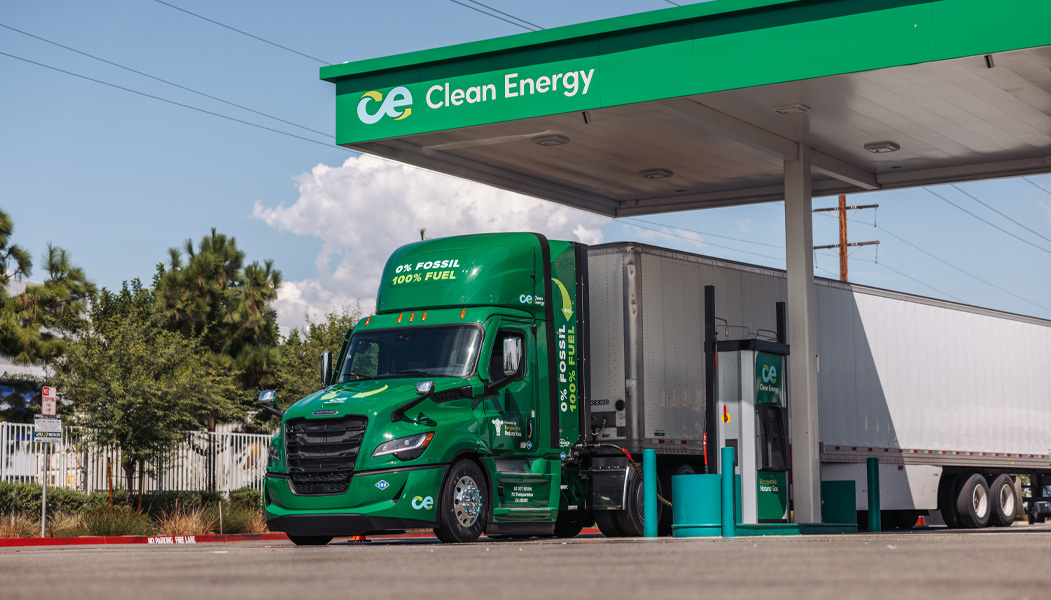
Diesel markets are once again reminding fleets how exposed they are to global events beyond their control. Recent geopolitical conflict has driven sharp diesel price spikes, creating immediate cost pressure for carriers and volatility that is difficult—if not impossible—to manage through traditional fuel strategies.
Renewable natural gas (RNG) offers a fundamentally different fuel equation. Produced domestically from renewable feedstocks such as landfills, dairies, and wastewater facilities, RNG pricing is not tied to global oil markets. The result is a fuel that is both price-stable and consistently cheaper than diesel—helping carriers protect margins while competing for freight with sustainability-focused shippers.
This is not a future technology or a pilot program. RNG is a proven, American‑made fuel that fleets can buy and use today—without waiting for charging infrastructure, grid upgrades, or power availability. Thousands of Class-8 trucks across the U.S. are already running on RNG, delivering diesel‑like performance with a fuel advantage that holds up when oil prices don’t.
Why RNG Is Showing Up in Freight Decisions
For many carriers, sustainability isn’t the primary driver—business is. But business is increasingly shaped by shipper expectations, particularly as more companies work to decarbonize their supply chains. Transportation is a significant part of Scope 3 emissions, and that pressure is now showing up in procurement conversations and RFPs.
RNG gives fleets a way to respond without taking on operational risk. Carriers running RNG-powered trucks can offer shippers a credible, scalable path to lower transportation emissions —without changing lanes, redesigning networks, or compromising service. When price and performance are comparable, RNG capability can be a meaningful differentiator in competitive bids.
As a result, companies across industries—including packaging and paper, food and beverage, industrial manufacturing, retail, and home furnishings—are not just expressing interest in lower-carbon freight; they are awarding business to carriers operating RNG trucks as part of their supply-chain decarbonization strategies.
Why RNG Counts in Shipper Sustainability Programs
RNG is produced by capturing methane from organic waste sources such as landfills, dairies, and wastewater treatment facilities—methane that would otherwise be released into the atmosphere. That methane is upgraded into vehicle fuel and used to displace diesel in heavy-duty trucking.
Because RNG avoids methane emissions upstream while replacing fossil fuel downstream, it delivers a significantly lower carbon footprint on a lifecycle basis. For carriers, this matters because RNG is increasingly recognized by shippers as a measurable biofuel solution that reduces Scope 3 emissions—without changing how freight moves.
Total Cost of Ownership That Competes—and Wins—Against Diesel
RNG trucks typically carry a higher upfront purchase price than diesel. That incremental cost, however, is offset through lower fuel costs, often within the first few years of operation depending on mileage and duty cycle. After payback, fleets benefit from ongoing fuel savings for the remaining life of the truck.
Historically, RNG fuel pricing has been lower and more stable than diesel, reducing exposure to volatility and improving cost predictability—particularly on high-mileage, repeatable routes.
Nationwide Fueling, Available Today
Unlike other alternative fuels that depend on future infrastructure development, RNG is available now.
Across the U.S., hundreds of public-access Class-8 RNG fueling stations are strategically located along major corridors and in key freight markets. This allows fleets to deploy RNG trucks without reengineering routes, sacrificing dispatch flexibility, or investing in private fueling infrastructure.
For fleets, that means RNG can be integrated into existing operations with minimal disruption—fueling where they already run freight.
Diesel-Like Performance with the Cummins X15N
Performance parity is non-negotiable in trucking—and RNG delivers. The Cummins X15N natural gas engine was designed for heavy-duty and long-haul applications, delivering up to 500 horsepower and up to 1,850 lb-ft of torque, with range and drivability suited for real-world operations.
Built in the U.S. by Cummins and available from Peterbilt, Kenworth, and Freightliner, the X15N allows fleets to spec RNG trucks through familiar OEMs, dealer networks, and service channels.
A Quieter, More Comfortable Cab for Drivers
Driver recruitment and retention remain persistent challenges for fleets. RNG trucks offer a practical advantage that matters on the road: strong driver acceptance.
Natural gas engines are significantly quieter than diesel, reducing cab noise and fatigue over long shifts. For many drivers, the overall experience is simply more comfortable. As fleets put RNG trucks into service, reports of driver resistance are low—and in many cases, drivers prefer natural gas equipment once they’ve spent time behind the wheel.
The Bottom Line for Trucking Companies
In a moment when diesel prices can spike due to global instability, RNG stands out as a stable, domestic, and cost‑effective alternative. It delivers predictable fuel costs, proven performance, nationwide availability, and a tangible advantage with shippers focused on Scope 3 emissions—available now, with no waiting and no operational disruption.
Renewable natural gas offers carriers:
- Competitive TCO and improved fuel-cost predictability
- Diesel-like performance from Cummins and leading OEMs
- Public-access fueling across major freight corridors
- A quieter, more comfortable driver experience
- A tangible edge with shippers focused on Scope 3 emissions
RNG isn’t about chasing sustainability trends. It’s a practical, proven solution that strengthens fleet economics—while helping carriers stay competitive for the long haul.


